 Admin
Admin 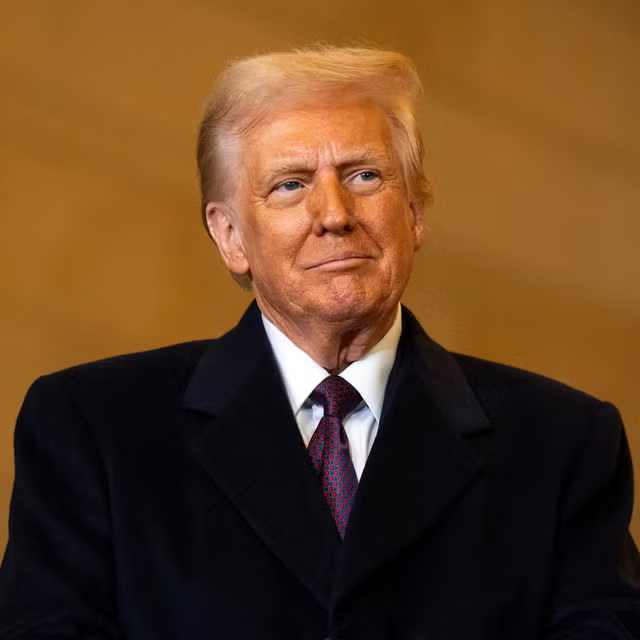
Donald J. Trump is one of the most polarizing and consequential political figures in modern American history. A real estate developer and media personality with no prior military or political background, Trump reshaped the Republican Party and American governance by winning the presidency in 2016 and staging a historic political comeback in 2024 to become the 45th and 47th President of the United States.
Quick Facts: Donald J. Trump
| Attribute | Details |
| Full Name | Donald John Trump |
| Born | June 14, 1946 (Queens, New York) |
| Political Party | Republican (previously Reform, Democratic, Independent) |
| Presidency | 45th U.S. President (2017–2021); 47th U.S. President (2025–present) |
| Education | Wharton School of Finance and Commerce, University of Pennsylvania |
| Key Mantras | “Make America Great Again” (MAGA), “America First” |
Early Life, Education, and Business Empire
Donald Trump grew up in Jamaica Estates, Queens, as the fourth of five children born to Fred Trump, a wealthy New York real estate developer, and Mary Anne MacLeod Trump.
- Education: Trump attended the New York Military Academy before studying at Fordham University. He later transferred to the Wharton School of Finance and Commerce at the University of Pennsylvania, graduating in 1968 with a bachelor’s degree in economics.
- The Trump Organization: Trump joined his father’s business, Elizabeth Trump & Son, shifting its focus from middle-class outer-borough rentals to luxury Manhattan developments. In 1971, he assumed control and rebranded the company as The Trump Organization.
- Manhattan Landmarks: His early marquee developments included the renovation of the Commodore Hotel into the Grand Hyatt New York (1980) and the construction of the 58-story Trump Tower on Fifth Avenue (1983), which served as his primary residence and business headquarters.
- Casinos and Expansion: During the 1980s and 1990s, Trump expanded into Atlantic City casinos (including the Trump Taj Mahal), airline shuttles, and golf resorts, surviving multiple high-profile corporate Chapter 11 restructurings.
Read more biography : Lea Michele Turns 40: Glee Fame, Career Highs & Life Today
Media Career and Pop Culture Stature
Decades before running for office, Trump cultivated an outsized public profile through television, publishing, and branding.
- Bestselling Author: In 1987, Trump co-authored Trump: The Art of the Deal, which spent weeks atop the New York Times bestseller list and cemented his reputation as a master negotiator.
- The Apprentice: In 2004, Trump debuted as host and executive producer of NBC’s reality television show The Apprentice. His catchphrase, “You’re fired!”, made him a household name for a new generation of Americans.
- Brand Licensing: The Trump brand expanded globally, licensing his name to residential towers, hotels, clothing lines, and consumer products.
The Political Ascent: 2015–2016 Presidential Campaign
Trump flirted with presidential politics in 1988, 2000 (with the Reform Party), and 2012. In June 2015, he formally launched his Republican campaign from Trump Tower, promising to “Make America Great Again.”
Running as an anti-establishment populist, Trump challenged orthodoxies in both major parties:
- Trade: Advocated protectionist tariffs over traditional free trade pacts.
- Immigration: Campaigned on building a wall along the U.S.–Mexico border and strict border enforcement.
- Foreign Policy: Promoted an “America First” doctrine, questioning multilateral alliances like NATO.
Despite trailing in major national polls against Democratic nominee Hillary Clinton, Trump won 304 electoral votes on November 8, 2016, pulling off an electoral upset by flipping traditional Democratic industrial states including Pennsylvania, Michigan, and Wisconsin.
Presidency (2017–2021): Landmark Policies and Major Crises
Trump’s first term fundamentally shifted domestic policy and judicial appointments while drawing continuous national and international debate.
1. Domestic and Economic Policy
- Tax Cuts and Jobs Act (2017): Enacted the largest overhaul of the U.S. tax code in three decades, lowering corporate tax rates to 21% and reducing individual income taxes.
- Judicial Reshaping: Appointed hundreds of conservative federal judges, including three U.S. Supreme Court Justices: Neil Gorsuch (2017), Brett Kavanaugh (2018), and Amy Coney Barrett (2020).
- Deregulation: Rolled back environmental, energy, and financial regulations to stimulate domestic manufacturing and energy production.
2. Foreign Affairs
- Trade Confrontations: Imposed tariffs on Chinese imports and renegotiated NAFTA into the United States-Mexico-Canada Agreement (USMCA).
- Middle East Accords: Brokered the Abraham Accords, normalizing diplomatic ties between Israel and Arab nations including the UAE, Bahrain, and Morocco.
- International Exits: Withdrew the United States from the Paris Climate Accord and the Iran Nuclear Deal (JCPOA).
3. Investigations and Impeachments
- Special Counsel Investigation: Robert Mueller’s two-year probe examined Russian interference in the 2016 election, finding no criminal conspiracy between the campaign and Russia while outlining potential instances of obstruction of justice.
- First Impeachment (2019): Impeached by the House of Representatives on charges of abuse of power and obstruction of Congress regarding military aid and political investigations in Ukraine; acquitted by the Senate in 2020.
- Second Impeachment (2021): Impeached following the January 6 Capitol riot on the charge of incitement of insurrection; again acquitted by the Senate.
Post-Presidency, Legal Battles, and the 2024 Comeback
Following his departure from office in January 2021, Trump retained a strong base within the Republican Party from his Mar-a-Lago estate in Florida.
Between 2023 and 2024, Trump faced four separate criminal indictments across state and federal jurisdictions. Rather than weakening his political standing, the legal challenges galvanized his core supporters. Trump swept the 2024 Republican primaries, survived an assassination attempt at a July 2024 rally in Butler, Pennsylvania, and defeated Democratic nominee Kamala Harris in the November 2024 presidential election to secure a non-consecutive second term.
Read more blog : Charles Esten: From Nashville Fame to His Life Today
Chronological Timeline of Donald Trump’s Political Life
| Year / Date | Major Political Milestone | Key Details |
| June 16, 2015 | 2016 Campaign Launch | Formally announced presidential bid at Trump Tower. |
| Nov 8, 2016 | Elected 45th President | Won 304 electoral votes against Hillary Clinton. |
| Jan 20, 2017 | 45th Presidential Inauguration | Sworn in as the 45th President of the United States. |
| Dec 22, 2017 | Tax Cuts & Jobs Act | Signed landmark domestic tax reform legislation. |
| Dec 18, 2019 | First Impeachment | Impeached by the House; acquitted by the Senate in Feb 2020. |
| Sep 15, 2020 | Abraham Accords | Brokered historic Middle East diplomatic peace pacts. |
| Jan 13, 2021 | Second Impeachment | Impeached post-Jan 6; later acquitted by the Senate. |
| Nov 15, 2022 | 2024 Campaign Launch | Announced bid for a second non-consecutive term. |
| Nov 5, 2024 | Elected 47th President | Won general election against Kamala Harris. |
| Jan 20, 2025 | 47th Presidential Inauguration | Sworn in for a historic non-consecutive second term. |
Frequently Asked Questions
Has any other U.S. President served non-consecutive terms?
Yes. Grover Cleveland was the first U.S. President to serve non-consecutive terms, serving as the 22nd President (1885–1889) and the 24th President (1893–1897). Donald Trump became the second in history to achieve this feat.
What were Donald Trump’s most significant legislative achievements?
His major domestic policy victories include the Tax Cuts and Jobs Act of 2017, the First Step Act (a bipartisan criminal justice reform law signed in 2018), and the appointment of three conservative Supreme Court justices who reshaped the judicial landscape.
What is the core philosophy behind “America First”?
The “America First” doctrine emphasizes national sovereignty, bilateral rather than multilateral agreements, tariffs to protect domestic manufacturing, strict border enforcement, and limiting foreign military interventions abroad.
About the Author


